
Russian Rapeseed Oil Market Report: Key Drivers, Risks, and 2026/2027 Outlook
We are pleased to present this analytical review, prepared by AB-Centre.ru and provided specifically for Rusagridata. The key indicators presented in this review are regularly updated in the Rusagridata Database under the “Oilseeds, Oils & Meals” section.
The Russian rapeseed oil market is characterized by:
1. A significant expansion of the raw material base for production
In 2025, Russia harvested 5,514.2 thousand tons of rapeseed, which is 18.4% (858.1 thousand tons) more than the previous year. The rapeseed harvested in 2025 served as the raw material for oil production throughout almost the entire 2025/2026 marketing year (July 2025 – June 2026).
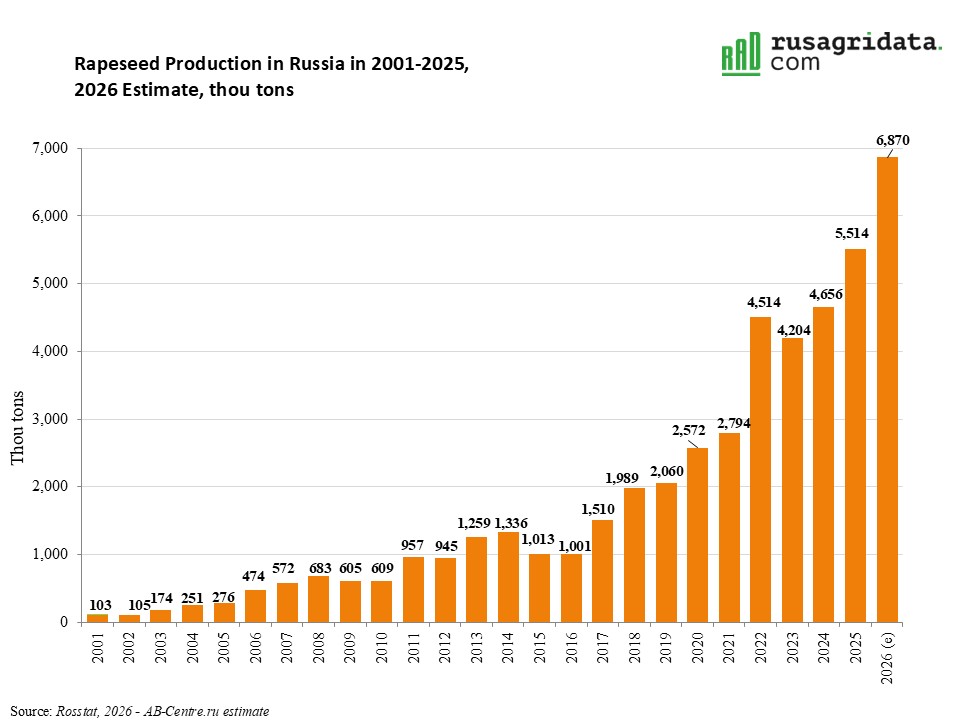
By the end of 2026, harvest growth is expected to continue. This is driven by a 29.6% expansion of the cultivated area. AB-Centre.ru expects the harvest to increase by 24.6% (1,356.0 thousand tons) to 6,870.2 thousand tons.
2. Growth in rapeseed oil production
In 2025, unrefined rapeseed oil production in Russia rose by 25.0% (308.7 thousand tons) to 1,543.5 thousand tons. In January-June 2026, it reached 866.2 thousand tons, exceeding the figures for the same period last year by 24.9% (172.5 thousand tons).
According to AB-Centre.ru calculations based on Rosstat data, unrefined rapeseed oil production in the 2025/2026 marketing year (July 2025 – June 2026) amounted to 1,716.0 thousand tons, which is 25.0% (343.1 thousand tons) higher than the figures for the previous marketing year.
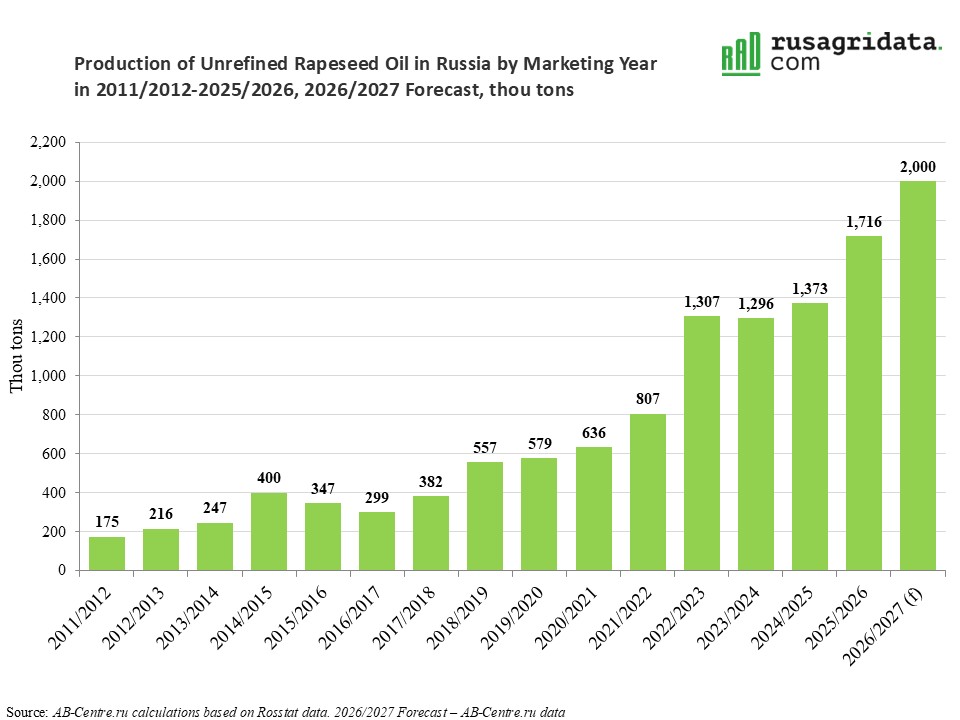
Given the dynamic expansion of the raw material base, production is expected to surpass the 2.0 million ton mark in the 2026/2027 marketing year.
As for refined rapeseed oil, its production volumes remain relatively small. Specifically, 72.6 thousand tons were produced in 2025, and 38.6 thousand tons were produced in January-June 2026.
3. Low profitability margins in rapeseed oil production
The profit margin for unrefined rapeseed oil production dropped to 3.71% in 2025, marking the lowest figure since at least 2017. However, profitability began to recover in 2026, reaching 4.53% in January-March 2026. The highest profitability levels were recorded in 2021 and 2023, standing at 10.96% and 11.14%, respectively.
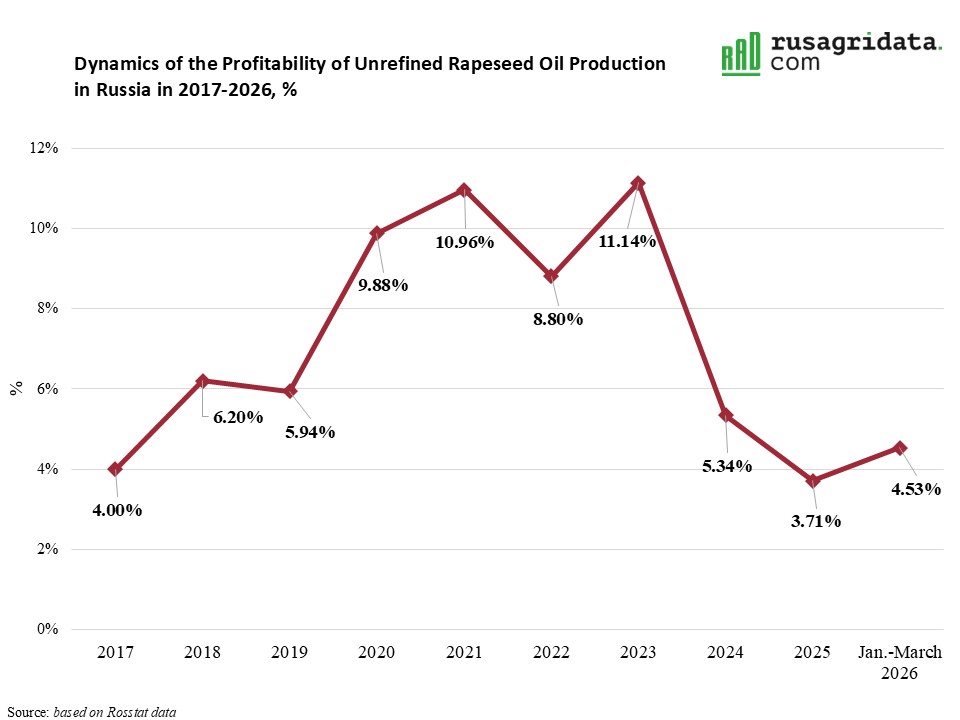
Regarding profitability, official Rosstat data are presented here. Actual profit margins may be higher.
4. A tangible increase in rapeseed oil exports
According to AB-Centre.ru data compiled from mirror statistics of foreign importing countries, Russia’s rapeseed oil export volume in 2025 stood at 1,377.5 thousand tons, which is 17.0% (200.0 thousand tons) higher than the previous year.
In the 2025/2026 marketing year (July 2025 – June 2026), exports approached 1.6 million tons. The key buyers are China and Norway.
During the 2025/2026 marketing year (July 2025 – June 2026), China’s imports of Russian rapeseed oil amounted to 1,483.5 thousand tons (AB-Centre.ru calculations based on monthly import data from the General Administration of Customs of China), while Norway’s imports totaled 40.0 thousand tons (Statistics Norway), bringing the combined total to 1,523.5 thousand tons. Other countries collectively purchased no more than 75 thousand tons of Russian produce.
Russian rapeseed oil exports are expected to surpass the 1.8 million ton mark in the 2026/2027 marketing year.
5. Risks to the industry associated with a lack of export diversification by country
Following the loss of European markets, China has become virtually the only major buyer of Russian rapeseed oil. Norway, the second-largest buyer, currently purchases tens of times less rapeseed oil from the Russian Federation than China.
As noted by AB-Centre.ru, export forecasting will heavily depend not only on Russia’s rapeseed harvest volumes and the expansion of rapeseed oil production. The key condition for export expansion is the corresponding demand from China. The entire rapeseed industry (including seed breeding, cultivation, oil production, storage, and logistics) is completely dependent on demand in the Chinese market. Even a minor drop in demand could severely impact the entire Russian sector. Meanwhile, domestic consumption of rapeseed oil in the Russian Federation remains low. According to AB-Centre.ru calculations, less than 12% of the domestically produced rapeseed oil is currently consumed within the country.
6. A slight increase in domestic consumption of rapeseed oil
In the 2025/2026 marketing year, consumption reached 200.0 thousand tons, including 180.0 thousand tons for food-grade purposes and 20.0 thousand tons for industrial needs (USDA data). While consumption stood at comparable levels a year earlier, it has noticeably grown over the past five years. Five years ago (in the 2020/2021 marketing year), it amounted to 130.0 thousand tons.
At that time, food-grade consumption was at 110.0 thousand tons, while industrial utilization, just like today, stood at 20.0 thousand tons.
In the 2026/2027 marketing year, rapeseed oil consumption in Russia is expected to increase to 210.0 thousand tons (driven entirely, as before, by food-grade consumption, while industrial demand will remain unchanged).
7. A high self-sufficiency ratio
The self-sufficiency ratio for rapeseed oil reached 838.5% in the 2025/2026 marketing year and is projected to hit 872.9% in the 2026/2027 marketing year. The self-sufficiency ratio is determined by AB-Centre.ru as the percentage ratio of total production to consumption volume.
8. Relatively stable price levels during the 2025/2026 marketing year
In Russia as a whole, prices for rapeseed and rapeseed oil in national currency terms decreased slightly during the 2025/2026 marketing year compared to the previous year.
This was largely facilitated by the increased rapeseed harvest in the country. However, the price softening was minor. A significant drop in prices was prevented by the growing demand for Russian rapeseed oil, primarily from China.
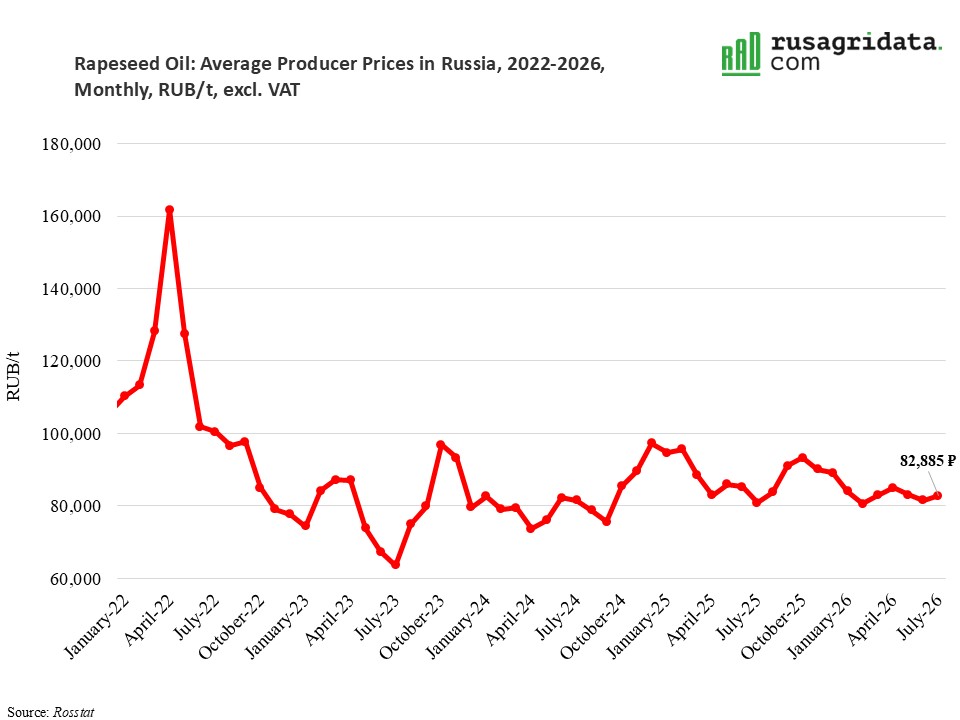
In US Dollar terms, due to the strengthening of the Russian Ruble (during the 2025/2026 marketing year), prices actually experienced a modest increase.
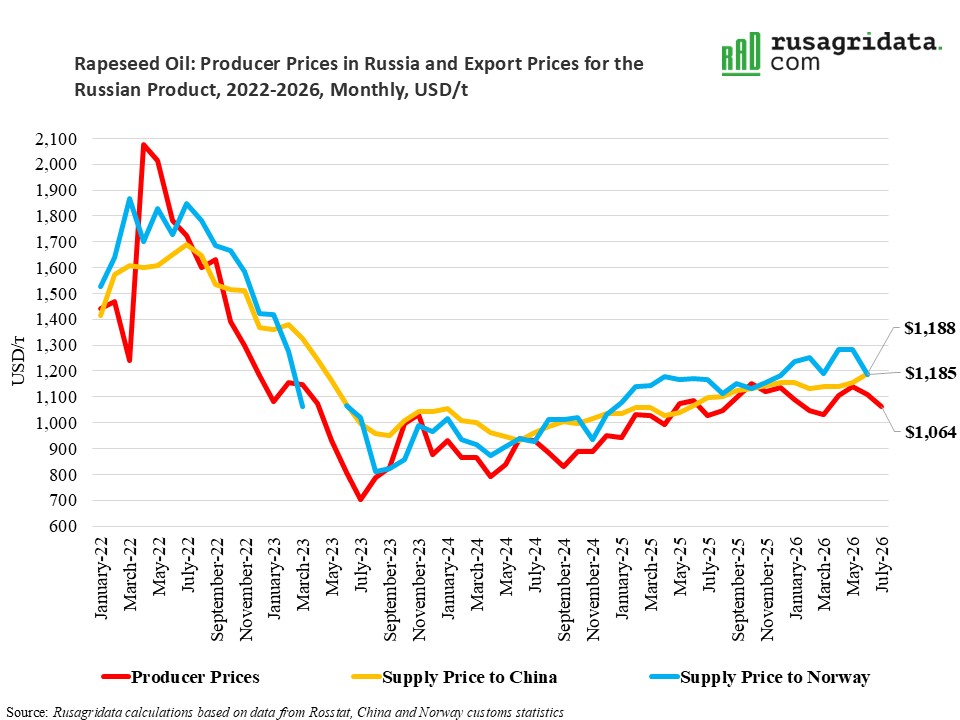
Overall, prices remained relatively stable throughout the marketing year, with no significant month-over-month price fluctuations recorded. Export prices for Russian rapeseed oil also remained at stable levels.
Source: AB-Centre.ru for Rusagridata. Any use of materials is permitted only subject to compliance with the public offer.